
You can set the goal, run the meeting, send the update, and still walk away feeling like you’re the only one who actually cares whether it succeeds. If you’ve managed a team for any length of time, you know this feeling. It’s one of the most demoralising parts of the job.
The instinct is to push harder. Tighten accountability. Make the consequences clearer. Sometimes that works in the short term. But you can’t discipline your way to a team that cares. You can only create the conditions where caring becomes possible.
CliftonStrengths® research points to something most management training misses: people don’t disengage because they lack discipline. They disengage because the connection between who they are and what they’re being asked to do has broken down. Fixing that connection is a manager’s job, and it starts with a different question.
You can’t discipline your way to a team that cares.
You can only create the conditions where caring becomes possible.
The wrong question is making the problem worse
Most managers, when faced with a disengaged team, ask: what’s wrong with these people? That question sends you down the wrong path. You start looking for the problem in the individual, and you miss the system you’ve built around them.
Gallup® has measured employee engagement across more than 160 countries. Globally, only 23% of employees report being engaged at work. In sub-Saharan Africa the figure is similar. That’s not a coincidence of individual attitudes. That’s a structural finding about how work is managed.
The number that matters more: managers account for 70% of the variance in team engagement. Your team’s level of care is, to a significant degree, a reflection of how you’re leading them. That’s a hard truth. It’s also useful, because it means the lever is in your hands.
Gallup® finding:
when managers receive strengths-based development, their teams show measurably higher engagement within weeks, not months.
The intervention doesn’t have to be large. It has to be specific.
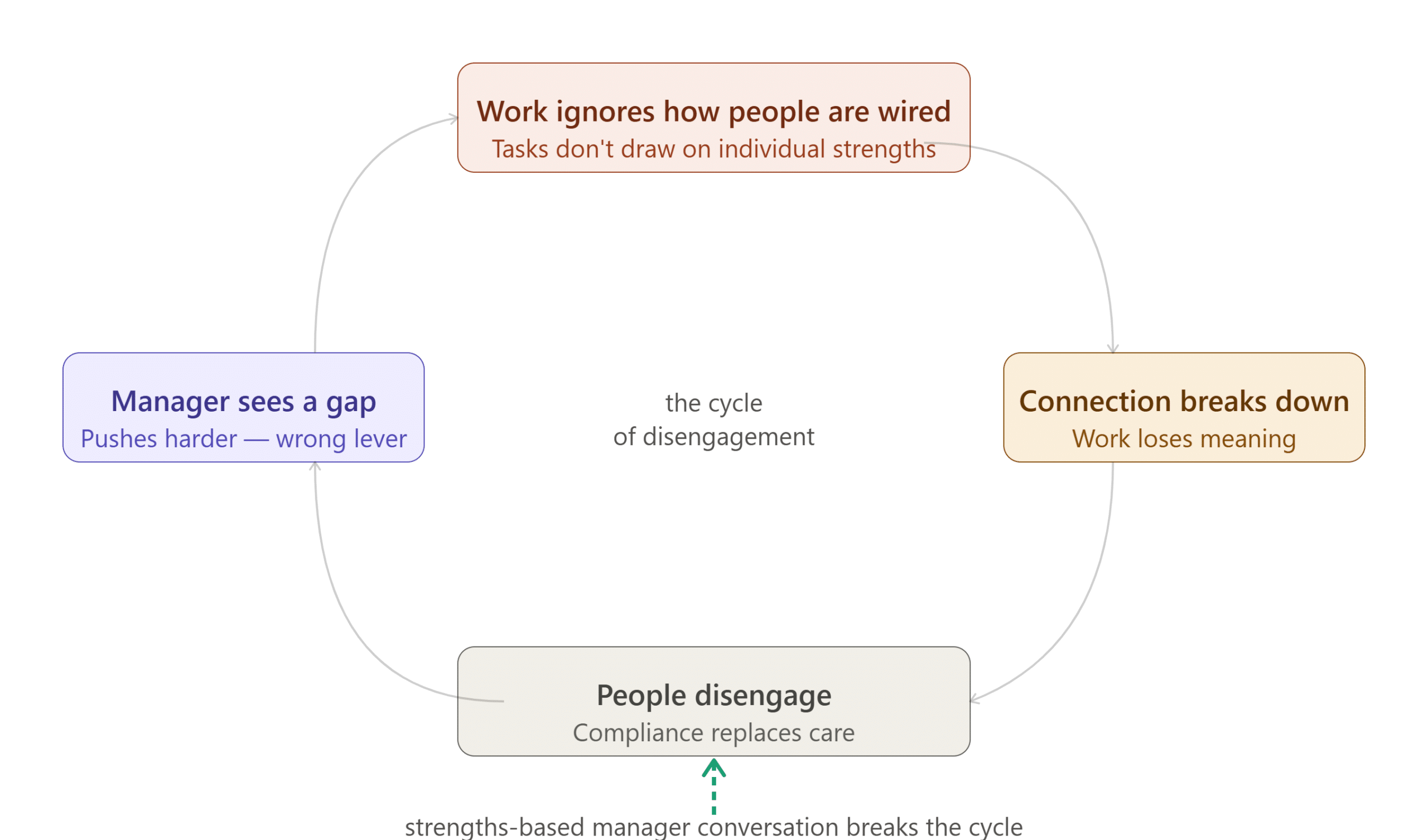
Care follows connection, not instruction
Think about the last time you felt genuinely invested in a piece of work. The task probably connected to something you’re good at, or something you find meaningful, or both. You weren’t more engaged because someone told you to be. You were engaged because the work itself gave you something.
Your team members are no different. Care follows connection. People invest in work that draws on their strengths, reflects their values, or links to an outcome they can see the importance of. When those elements are absent, you get compliance at best. You cannot convert compliance into care through pressure.
CliftonStrengths® gives you a map of what those connection points are for each person on your team. A team member with Responsibility in their top themes will care about owning a piece of work completely and delivering it without fail. Give them a role with genuine ownership and they’ll hold themselves to a standard you never have to enforce. A team member with Learner will care deeply about work that stretches them. The moment the role goes stale and repetitive, they disengage, and no amount of performance management reverses it.
The point is not that you restructure everything around individual preferences. The point is that you manage each person with a working knowledge of what connects them to their work, and you use that knowledge when you set tasks, give feedback, and have performance conversations.
Three things managers do that kill care
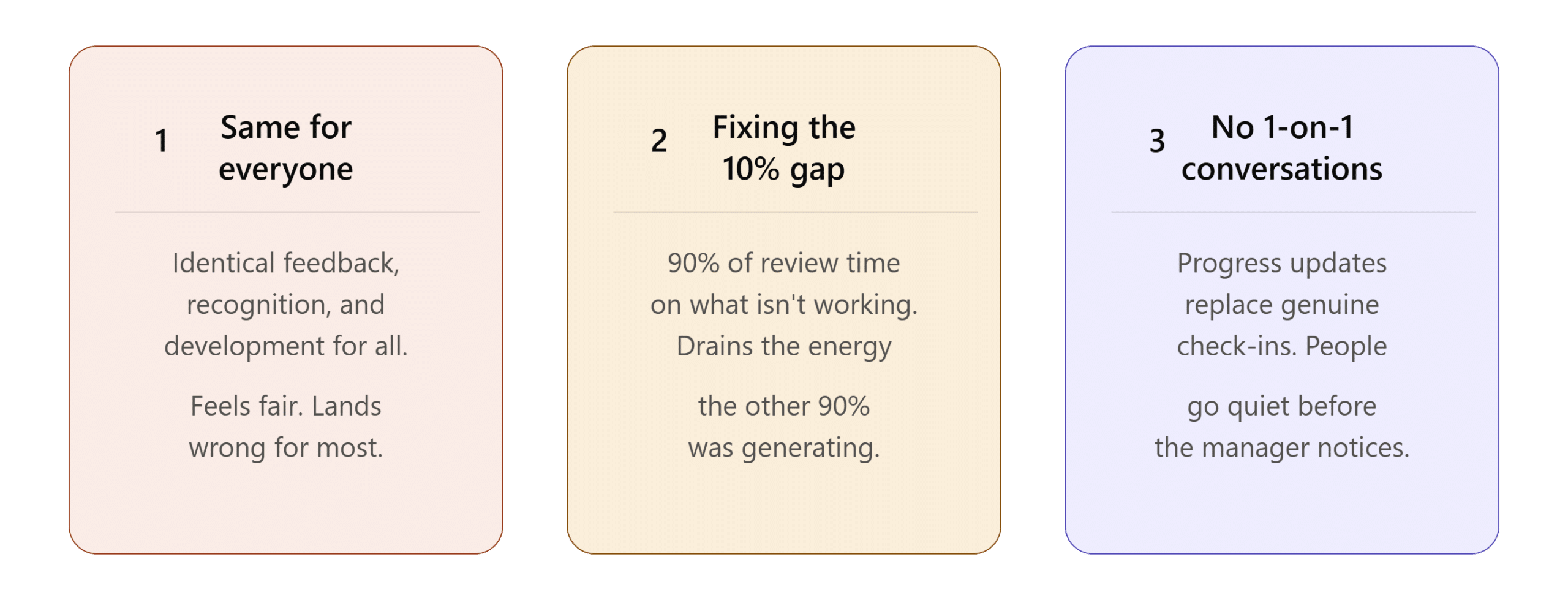
Before looking at what builds engagement, it’s worth naming what destroys it. These are the three patterns Gallup® research identifies most consistently in disengaged teams.
Treating everyone the same
Fairness and uniformity are not the same thing. A manager who gives every team member identical feedback, recognition, and development conversations is being consistent, not fair. One person’s version of feeling valued is public acknowledgement. Another person’s is being given a harder problem to solve. Managing as if these are interchangeable produces resentment in both directions.
Correcting weaknesses instead of deploying strengths
The dominant model of performance management focuses on gaps. Identify what’s missing and fix it. Gallup®’s research across decades suggests this approach is backward. People who spend the majority of their time working in their areas of strength are significantly more productive and report higher wellbeing. Spending 90% of a performance conversation on the 10% that isn’t working drains the energy that the other 90% was generating.
Skipping the individual conversation
Gallup® data shows that employees who have regular, meaningful conversations with their manager are significantly more engaged than those who don’t. Not team meetings. One-on-one conversations where the manager is genuinely trying to understand how that person is doing and what they need. Most managers don’t skip these conversations because they don’t care. They skip them because they feel time-poor and the conversation doesn’t have a clear agenda. Knowing someone’s CliftonStrengths® profile gives you the agenda. You already know what matters to this person.
Employees who spend most of their time in their areas of strength are more productive and report higher wellbeing.
A performance conversation that focuses on what isn’t working misses the point.
What getting your team to care actually looks like
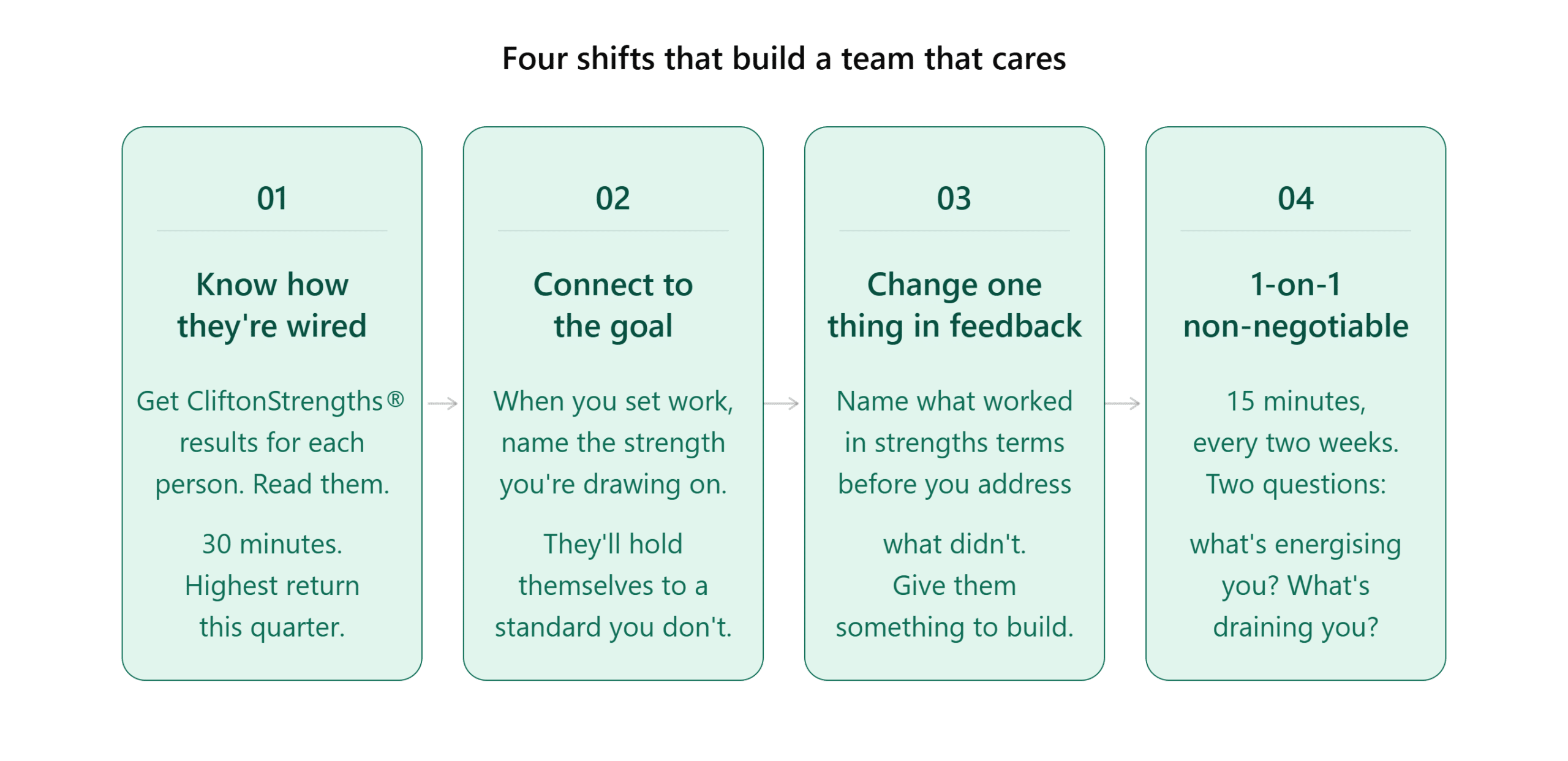
It doesn’t require a team-building day or a new performance framework. It requires four practical shifts.
Know how each person on your team is wired.
Get their CliftonStrengths® results. Read the themes. Have a conversation with each person about which ones feel most accurate and where they think they’re being underused. This is the highest-return 40 minutes you will spend on your team this quarter.
Connect individual strengths to team goals.
When you set work, name the strength you’re drawing on. ‘I’m giving you this project because your Analytical theme means you’ll spot the flaw in the data that everyone else will miss.’ That sentence does three things: it tells them why they were chosen, it connects the task to something real about them, and it sets a standard they’ll hold themselves to.
Change one thing about how you give feedback.
Before you address what didn’t work, name what did, in specific strengths terms. ‘The way you held the client relationship through that difficult brief shows exactly what your Relator theme does when it’s working.’ That’s not flattery. It’s accurate observation, and it gives the person something to build on rather than just a gap to close.
Make the individual conversation non-negotiable.
Fifteen minutes every two weeks, one-on-one, with a genuine question rather than a progress report. ‘What’s energising you right now? What’s draining you?’ Those two questions, asked regularly and listened to, produce more actionable information than any engagement survey.
The question underneath the question
When a manager asks how to get their team to care, they’re often really asking: why does this feel so hard? The honest answer is that caring cannot be manufactured through process or policy. It grows in environments where people feel known, used well, and connected to something that matters.
Building that environment is not a personality trait some managers have naturally. It’s a set of practices that can be learned. CliftonStrengths® is one of the most practical tools available for building those practices, because it makes the invisible visible. It turns a vague sense that ‘this person is disengaged’ into a specific hypothesis about why, and a specific place to start.
Your team will care when they believe you care, specifically, about who they are and not just what they produce. That starts with knowing them well enough to tell the difference.
Help your team find what they do best
CliftonStrengths® Codes, Team Sessions & Manager Coaching across Africa
www.bhgroup.africa
If you want to know talk to one of our team members about the strengths-based approach, click on the button to send us an email.